
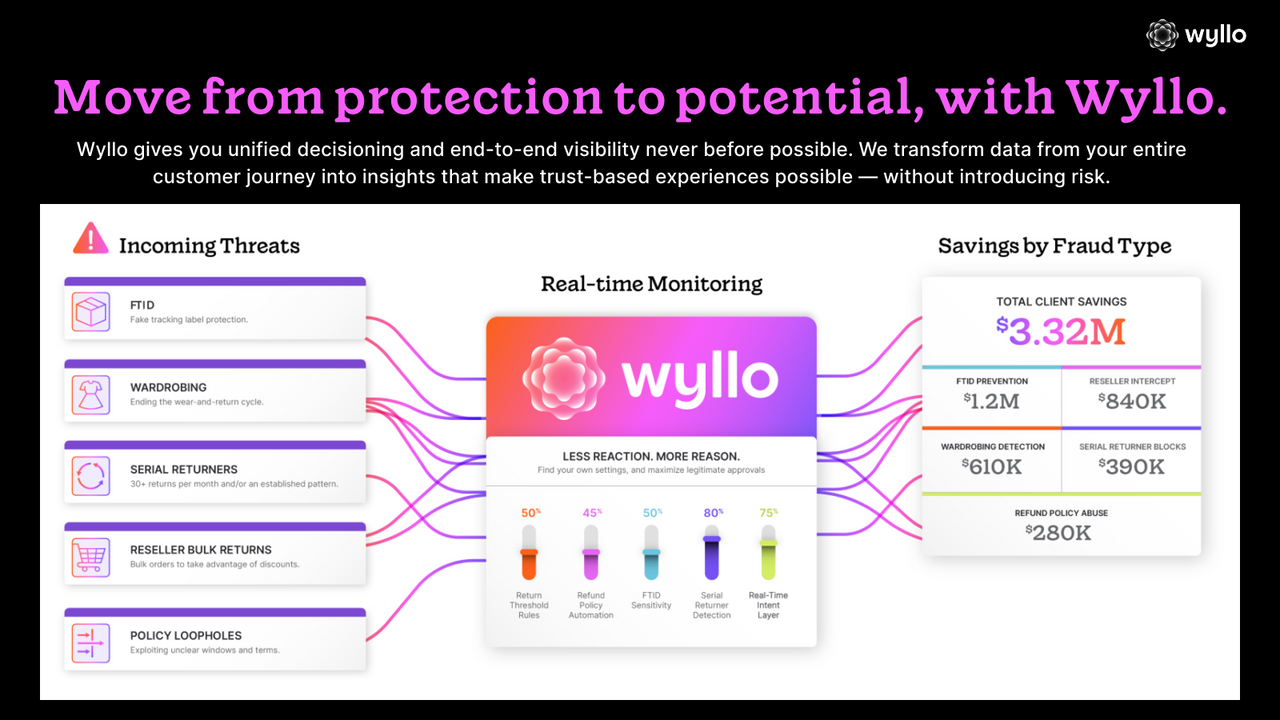
Wyllo, formerly NoFraud, has expanded from checkout fraud screening into a broader risk intelligence platform for fraud, policy abuse, and post-purchase decisions. For Shopify merchants, the practical value remains clear: screen orders, choose whether to pass, hold, or cancel them, and use optional manual review and chargeback guarantees on paid plans. It suits businesses whose fraud losses or review workload are large enough to justify a serious operating cost. It is not a cheap plug-in for a store that only sees an occasional suspicious order.
Key features
- Order risk screening: Wyllo evaluates payment fraud and other risk signals, then supports pass, hold, and auto-cancel decisions.
- Controls for specific patterns: Custom rules, blocklists, geolocation tools, fraud filters, and automated workflows give a merchant more control than a basic risk score.
- Manual and identity review: Paid plans can add expert manual review and branded verification for orders that need a closer look.
- Broader abuse prevention: The current platform also covers bot and reseller activity, return fraud, claims, and policy abuse, with risk context that can extend to customer support.
- Reporting and alerts: The app lists high-risk and chargeback alerts, notifications, risk reports, and chargeback analytics.
Pricing and trial information
Wyllo is free to install. The first screened order starts a 14-day trial, after which the Screening Only tier includes up to 100 screened orders a month at no charge. Paid plans start at $250 a month or 1% of revenue, with a $250 monthly minimum for merchants below $50,000 in monthly revenue. The next published tiers are $350 a month or 1.25% of revenue, and $450 a month or 1.5% of revenue, each with a corresponding monthly minimum. Wyllo asks larger merchants to contact it for custom pricing.
The paid plans list a guarantee on fraud chargebacks Wyllo passes, plus optional expert manual review and branded verification. Their plan cards cite guarantee levels of $500, $1,000, and $2,000. Confirm the commercial terms, payment methods, order types, and eligibility before treating a guarantee as part of your margin model.
Rating and reviews
Wyllo has a 4.9 out of 5 rating from 152 Shopify App Store reviews at the time of writing. The long-term reviews are unusually useful: merchants praise higher approval rates, low manual-review workload, clear reporting, and responsive support. One recent review also makes the important point that manual review still happens sometimes. That is a healthy expectation, not a failure of the tool. Fraud prevention is a decision system, not a promise that every good order will pass automatically.
Pitfalls
- Pricing needs a real ROI calculation. The free tier is a way to test screening, not full free protection. A percentage-of-revenue fee can become material as the store grows.
- Guarantees have boundaries. Read the actual coverage and submission requirements before relying on one. A guarantee for orders Wyllo passed is not the same as blanket insurance for every dispute.
- False declines and customer friction still matter. Test pass rates, review time, and the experience of legitimate customers, particularly for high-value or international orders. Our guide to optimizing Shopify checkout is a useful companion when you assess that trade-off.
- Review native protection first. Shopify’s own fraud analysis and payment protections may already cover part of your workflow, depending on your payment setup and order eligibility. Compare the coverage before paying for overlapping protection.
- The brand is changing. Wyllo is the current name for the former NoFraud business, so you may still encounter NoFraud in older reviews, documentation, or integrations.
Conclusion
Wyllo is a strong option for established Shopify brands that need to reduce fraud loss without simply rejecting more orders. The mix of screening, manual expertise, abuse controls, and guarantee-backed decisions is more substantial than a basic fraud filter. Start with the 14-day trial and measure approval rate, fraudulent orders that reach fulfillment, manual workload, and chargebacks. If those results do not justify the revenue-based fee, the free screening tier and Shopify’s native safeguards may be enough for now.