
Boost AI Search is listed in the Shopify App Store as Boost AI Search & Filter and in its own documentation as Boost AI Search & Discovery. It is a complete platform that replaces or extends native search and collection navigation, and adds merchandising, recommendations, bundles, pre-orders, back-in-stock alerts and analytics. That suits large catalogs and merchandising teams, but it can be more than a small store needs.
Key Features
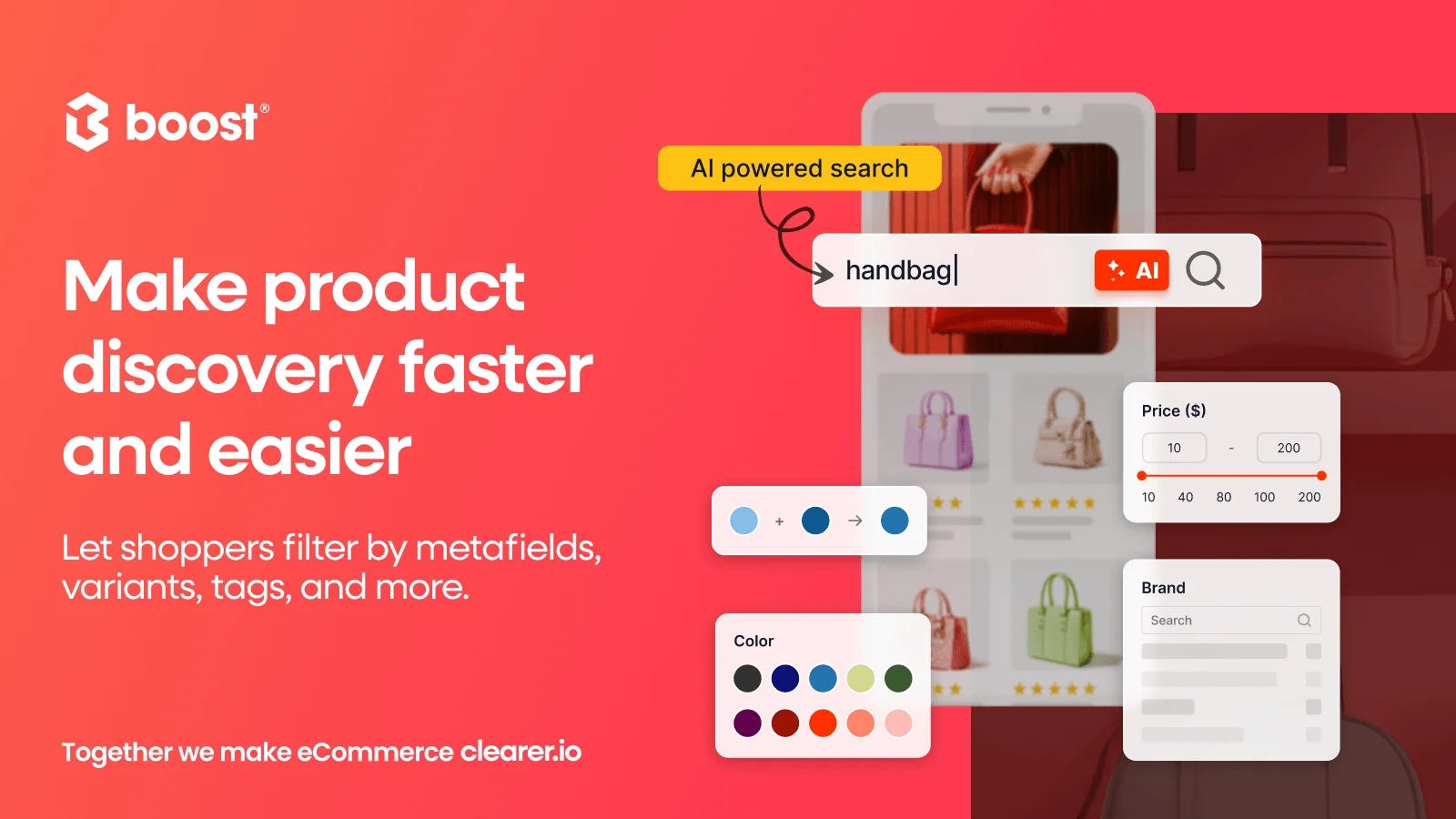
- Smart and AI search: Handles typos, vague queries, synonyms, stop words, redirects and no-result searches, and lets you choose which fields are searchable.
- Advanced product filters: Separate filter trees for collections and search, built on tags, metafields, variants, availability, custom values, layouts and display styles.
- Visual merchandising: Pin, boost, demote, hide and sort products, and run campaigns that follow your commercial priorities.
- Recommendations and bundles: AI or rule-based recommendations, frequently bought together, predictive bundles, pre-order and back-in-stock, depending on plan and version.
- Analytics and international selling: Reporting on queries, zero-result searches, filters, products and conversions, with Shopify Markets, multiple languages and currencies, and a long integration list.
Pricing and Trial Information
Boost includes a 21-day free trial. Launch starts at $29 per month and can reach $159 for stores under $50,000 in monthly GMV. Convert starts at $299 and goes up to $599 under $400,000. Accelerate starts at $699 and reaches $1,499 under $2.5 million. Enterprise is quoted individually.
Base GMV is the average of the previous three full months, calculated from catalog prices before discounts, taxes, shipping and returns. Above your tier limit, Boost can add $2 for every $1,000 of extra GMV, with its own capping rules. Model the cost against current and expected revenue rather than the $29 entry price. Limits on filter trees, campaigns, sync frequency, data history, personalization and B2B also differ by plan.
Rating and Reviews
Boost currently holds 4.8 out of 5 stars from roughly 1,500 Shopify App Store reviews, with about 94% of them at five stars. Reviewers repeatedly praise the flexibility of the search and filters, reliability on large catalogs, and fast support on styling, theme changes and custom storefront issues.
The small number of critical reviews matters, because Boost changes customer-facing parts of the store. They mention conflicts with themes or other apps, a setup that is too broad for a simple catalog, and leftover code or hidden native sections that need cleaning up after uninstalling. Good support lowers that risk, but it does not replace a careful implementation.
Pitfalls
GMV-based pricing is less predictable than a fee tied to product count or query volume. A store can move into a higher tier or pay overage as revenue grows, even when search usage stays the same. Not every advertised feature is available at $29. Personalization, the number of filter trees, campaigns, data history, sync frequency, B2B and notifications all depend on the package.
Boost touches search, collections, recommendations and sometimes bundles, so theme compatibility, template, app version and integrations decide how smooth the rollout is. An unsupported or heavily customized theme may need a Boost template or developer work. Boost recommends Theme Revert before uninstalling; without it, theme code or hidden native product grids and search results have to be restored by hand.
The app also requests broad access to customers, products, full order history, discounts, themes, translations, Markets and inventory. Some recommendation algorithms need order data. Check that every feature you switch on justifies that access, and test relevance, mobile layout, accessibility, analytics and fallback behavior before native components are replaced.
Conclusion
Boost AI Search fits stores where product discovery is commercially important: large catalogs, frequent campaigns, multilingual Markets and a team that acts on search data. The feature set and the support are strong, but a simple store should try Shopify Search & Discovery first. Before subscribing, work out the GMV-based cost, list the premium features you actually need, and test your theme inside the 21 days. If you want the implementation done properly or reviewed independently, our Shopify support service covers themes, apps and conversion flows.