
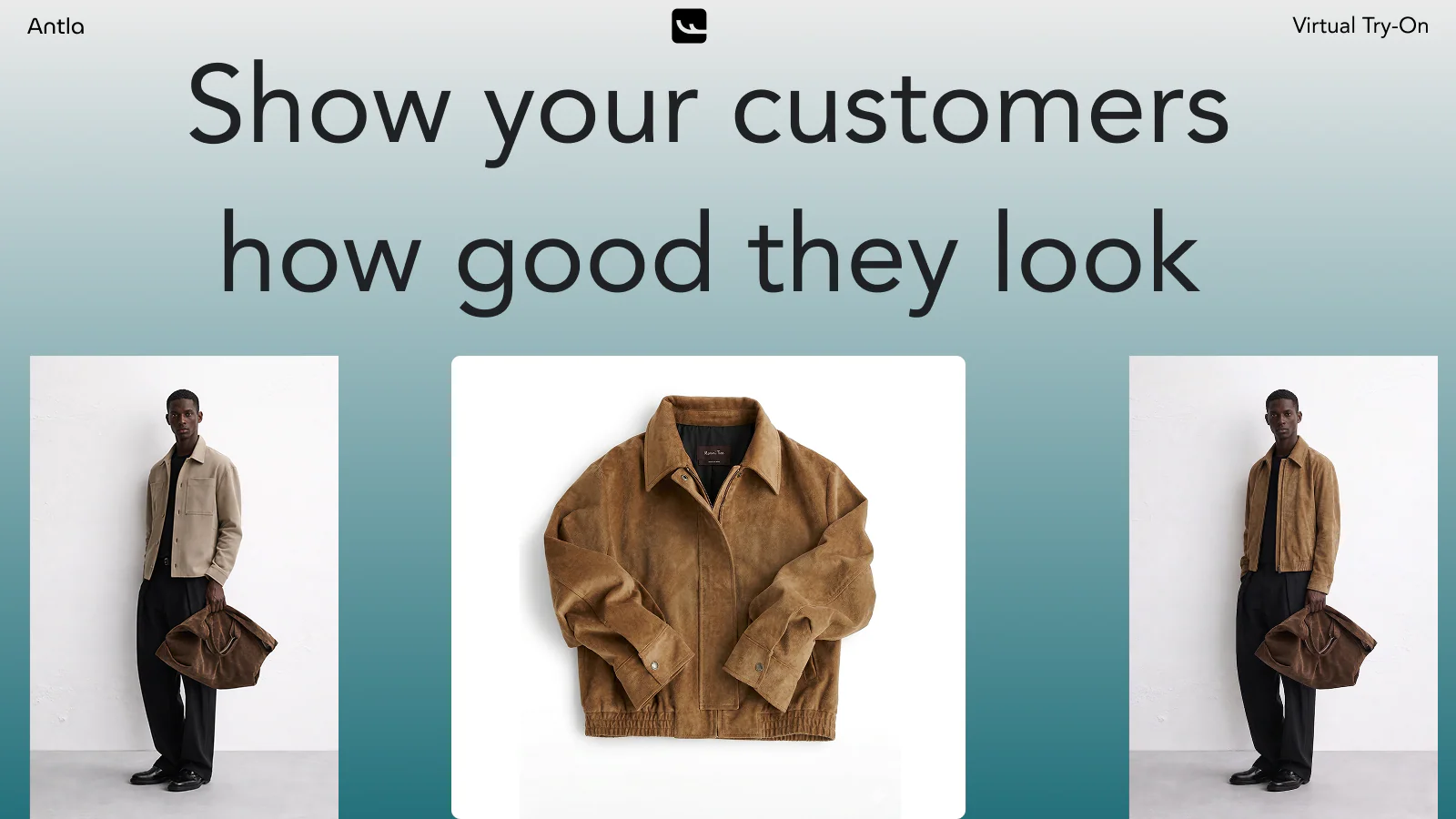
Antla adds AI virtual try-on to Shopify product pages. A shopper uploads a photo and receives an image showing them with the selected product. The app is Built for Shopify and positions itself as a companion to size charts, not a replacement. That distinction matters: Antla can visualize how an item may look, but it does not guarantee size, fit, or real-world measurements.
Key features
Antla organizes products into what it calls funnels. Merchants choose a product type, such as tops, pants, or full-body outfits, then add products manually or with automated rules. Two generation models are available. According to the developer documentation, Antla Fast usually takes about 13 seconds, while the more detailed Antla Pro takes roughly 25 seconds.
- Experience editor: merchants can customize text, colors, border radius, logo, background image, buttons, and button destinations.
- Variants and cart: shoppers can select a size or color and add the product to cart from the try-on experience.
- Size-chart support: Antla works alongside sizing information and can show guidance for taking a better shopper photo.
- Discounts and sharing: automatic discounts, email delivery, and result sharing can extend the journey after generation.
- Analytics: the dashboard tracks try-ons, top-performing products, shares, and attributed conversions.
- Integrations: the official listing names Flow, Klaviyo, Attentive, Postscript, Dondy, Segments, and Checkout. Higher plans also include custom events for tailored integrations.
The storefront experience is responsive and its copy is customizable. The Shopify listing names English as the app language, while the developer says the widget can operate on stores using any language.
Pricing and trial information
Antla does not offer a free plan. Trend costs $19.99 per month and includes 100 try-ons, with additional usage charged at $0.16 per try-on. Runway costs $49.99 for 500 try-ons, then $0.12 per additional use. Unlimited Fashion costs $199.99 for 2,000 try-ons, then $0.09 per use. Every plan includes a 7-day free trial.
Runway adds full customization and embedding, priority support, developer documentation, custom events, and Klaviyo access. Unlimited Fashion targets higher-volume brands with priority generation, a dedicated server, technical support, and a customer success manager. Because the bill combines a subscription with usage, merchants should estimate cost from product-page traffic and expected adoption, not only the monthly fee.
Rating and reviews
At the time of review, Antla has a 5.0 rating from 49 Shopify reviews, all of them five stars. Recurring themes include quick setup, perceived output quality, and especially responsive support for placement and design changes. One visible review comes from a merchant after four months of use, although several recent reviews were submitted after only hours or days.
This is a very positive early signal, but it is not independent proof of the developer's claims about conversion lift, return on investment, or reduced returns. The sample size and usage history are still limited for those conclusions.
Pitfalls
Output depends on the shopper's pose, lighting, background, and the product imagery. Antla's documentation acknowledges that the Fast model can struggle with unusual poses, complex scenes, or multiple people. Credit-based billing can become expensive at higher engagement. The app requests broad access to customers, products, recent orders, discounts, analytics, the theme, and files. Its custom-event documentation also shows that merchant scripts can receive customer details and URLs for uploaded and generated images. The privacy policy describes data categories and general rights, but does not clearly state photo-retention periods or whether photos are used for model training. Merchants should obtain those answers, limit integrations, and review consent and privacy notices before launch. This is not legal advice.
Conclusion
Antla is a strong option for fashion brands that want a deeply customizable try-on experience, marketing integrations, and better measurement than a basic widget. I would start with a small product group, test both models on mobile and with realistic shopper photos, then compare add-to-cart activity, conversion, and returns with the actual credit cost. A small store that needs a free plan, or a team that requires more specific privacy documentation before testing, will probably be better served by an alternative.