
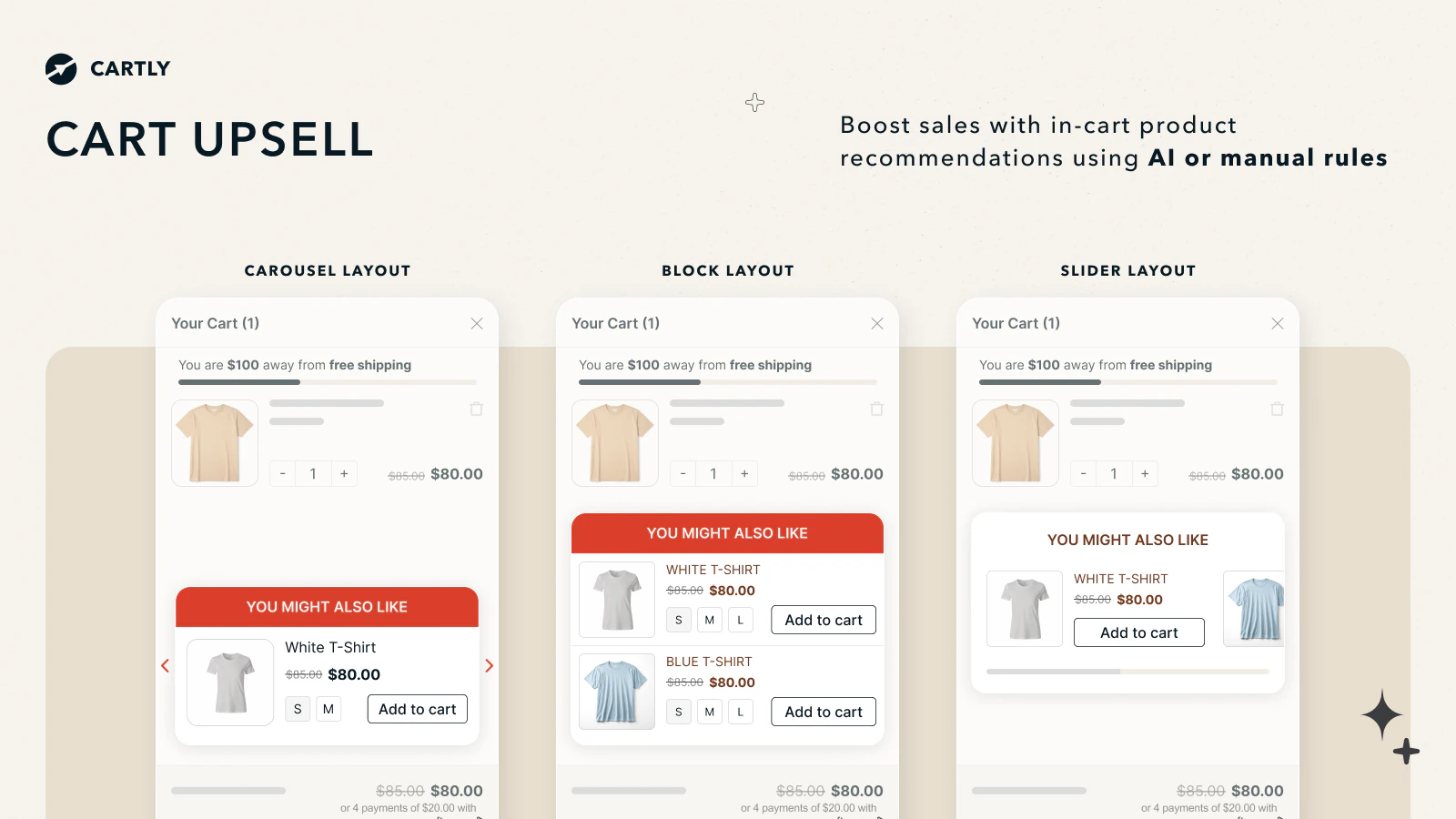
Cartly Slide Cart Drawer replaces Shopify's default cart with a customizable side drawer designed to keep shoppers on the current page. It combines upsells, add-ons, rewards, urgency tools, discount entry, and checkout shortcuts in one app. Cartly is Built for Shopify and is a practical choice for merchants who want a broad feature set without choosing separate modules, provided its order-based pricing fits their store.
Key features
- Customizable, mobile-responsive cart drawer with brand styling and optional custom CSS or JavaScript
- Shopify-recommended or manually triggered upsells and cross-sells, with optional product discounts
- Product add-ons, volume discounts, subscription offers, and recommendations for an empty cart
- Reward bar with up to three tiers for free shipping, discounts, free gifts, or custom rewards
- Announcement and countdown bar, discount-code field, order notes, trust badges, delivery information, and terms checkbox
- Sticky add-to-cart, quick-buy, buy-now, skip-cart, and accelerated checkout options
- Installment messaging, multi-currency and storefront translation controls, plus recommendation analytics
The listing names Checkout, Shopify Admin, Affirm, AfterPay, GemPages, and Klarna as integrations. The help center also documents Sezzle and Shop Pay Installments. Express and installment buttons only display providers already enabled in the store's Shopify payment settings. The terms checkbox can record an acknowledgement, but the merchant remains responsible for the wording and consent process required by their business.
Pricing and trial information
The free plan includes all features and is available until the store reaches 20 total orders. Development stores can use every plan for free. Paid pricing then scales with the store's monthly order volume: $16.99 per month for up to 100 orders, $24.99 for 101 to 300 orders, and $49.99 for 301 to 750 orders. The developer also advertises an Enterprise plan at $199.99 per month for unlimited orders, with an account manager, dedicated Slack channel, custom integrations, and priority feature implementation.
Every paid plan includes a 14-day free trial. The important detail is that the threshold refers to total store orders, not only orders influenced by Cartly. A growing store can therefore move through pricing tiers even if its use of upsells stays unchanged.
Rating and reviews
Cartly has a 4.9 rating from 82 Shopify App Store reviews. At the time of review, 77 were five-star ratings, while each rating level from one to three stars had one review. Merchants most often praise the responsive support, clear setup guidance, customization, and breadth of features. Some reviews report conversion or AOV improvements, but these merchant claims are not independent measurements and results will depend on traffic, products, offer design, and theme setup.
The most useful negative review reported cart state problems, slow page behavior, broken link responses, and a conflict with the theme's existing cart. The merchant had used the app for only about two hours, so it does not establish a widespread issue, but it is a concrete reason to test Cartly on a duplicate theme across mobile and desktop before enabling the app embed for customers.
Pitfalls
Cartly's free allowance ends after only 20 total store orders, and paid prices rise with the store's full monthly order count rather than app-attributed revenue. The App Store lists English as the app language, although storefront copy can be translated in the settings. Its many cart and checkout changes also make theme, discount, subscription, and payment testing essential, especially given the detailed incompatibility report in the reviews.
Conclusion
Cartly is a strong all-in-one cart drawer for merchants who want upsells, multi-tier rewards, add-ons, sticky buying tools, and checkout shortcuts without feature gating between the standard order tiers. Its Built for Shopify status, current 4.9 rating, and support feedback are reassuring. The main decision is economic: compare its store-order pricing with the incremental value the drawer actually creates. Define a focused upsell strategy, test the implementation on a duplicate theme, and measure revenue per visitor rather than relying on the app's feature count alone.